How China’s Deaf Delivery Riders Find a New Life in Gig Work
On New Year’s Day in 2023, at a food festival in the eastern Chinese city of Nanjing, my student and I came across four deaf food delivery riders waiting for orders, chatting in sign language. One was proudly showing a speedy electric bike he had just bought for 10,000 yuan ($1,450), a considerable sum. Another ran his hand along the frame and said he had earned 9,000 yuan the previous month and hoped to save enough this month to buy one too. A third rider shared a different, though equally optimistic, plan: to deposit his earnings in the bank, give money to his parents during the coming Chinese New Year, build a house, and get married.
China’s army of delivery riders, the backbone of China’s e-commerce sector, has received significant attention in recent years. Journalists and academics alike have written about how their work is precarious, their hours long, and their protections limited. A courier’s memoir about how tough the work is, “I Deliver Parcels in Beijing,” became a bestseller.
Imagine our surprise when we witnessed the deaf riders’ upbeat talk of new vehicles, marriage, and homebuilding. And the more we researched this group of workers — including in-depth interviews and observation of 22 deaf couriers in Nanjing — the more we saw this more positive picture. Unlike many hearing riders, who often regard the job as temporary and rate their socioeconomic status relatively low, deaf riders tend to place a high value on their work and gain confidence from it.
Our interviewees had previously worked in factories, construction, dishwashing, and other jobs they described as “low skill, low wage.” Cui Hao, 30, had tried many trades, each ending in frustration. “At 18, I washed dishes. At 19, I worked in clothing manufacturing. At 20, I went to a construction site, 120 yuan a day, 14 or 15 hours, exhausting. At 21, I washed cars in Linyi. At 22, back to construction. At 23, garments in Changshu. At 24, I worked as a food runner.” He “hated every job he did,” Cui said, before finally becoming a delivery rider at age 25.
Other deaf riders felt working in electronics, garment, and toy factories was like being a cog in a machine, with little rest and many arbitrary reasons their wages would be cut. Even when their output matched that of hearing workers, their pay was lower. Some factories openly framed hiring disabled workers as an act of “benevolence” to justify low wages; others were quick to lay off disabled employees in the slow season. Being discriminated against by management and isolated by hearing coworkers was commonplace.
By contrast, most deaf interviewees described becoming delivery riders as turning a new page, one of less discrimination and greater autonomy. Delivery platforms offer features that make interacting with restaurants and customers easier, such as voice-to-text conversion, pre-written messages, and digital badges that will alert users that the rider is deaf. Wages and bonuses are calculated by formulas, not arbitrary decisions, and as such are quite high for deaf workers. Our interviewees’ average monthly income exceeded 8,000 yuan, excluding tips. Several even stood out as “top performers,” beating many hearing colleagues. Zhou Jie, 32, who completes more than 330 deliveries a week and earns nearly 15,000 yuan a month, often emphasized to us that “there’s no difference between deaf and hearing people; if you work hard, you can make money.”
Relations between deaf riders, shops, and customers also tend to be relatively smooth. Because of the language barrier, conflicts over delays are less likely to escalate. When customers are informed that a deaf rider will deliver their order, they are often more patient and tolerant. Some riders shared stories of appreciative customers giving them bottled water and snacks. Our research found that ratings and tips for deaf riders were generally higher than for their hearing counterparts, reflecting a degree of consumer support for deaf employment.
Perhaps the more profound shift lies in how the work reshapes confidence in social interactions. Many interviewees said that, for the first time, they were being recognized and praised for their strong job performance. That, in turn, encouraged them to engage more confidently with hearing coworkers. When Long Fei, 32, first entered the field, he was too timid to greet hearing riders at his dispatch station. Six months later, when we accompanied him on deliveries, he not only greeted them readily but spent his free time drinking and gaming with them.
The shift in occupation has also reshaped deaf delivery riders’ relationships with their families, impacting their lives on a deeper level. In their accounts, they often divide their relationship with their parents into two phases: before and after starting to deliver food. Some riders note that, compared with their hearing siblings, they received greater care from their parents, including the cost of attending schools for the deaf and sustained emotional support. At the same time, parents often sought to control nearly every aspect of their lives, making decisions on their behalf. Some riders recall their parents monitoring their social life to prevent them from being bullied, while also intervening in their career choices and personal finances.
For some, becoming a delivery rider effectively marked the beginning of independent adulthood. They achieved financial autonomy and gained greater leverage within family relationships. Some began to give back to their parents. Hu Bing, 27, returned home for the Chinese New Year with red envelopes totaling 4,000 yuan and four bottles of expensive Moutai liquor. “They used to take care of me,” he said. “Now I can earn money by delivering food, so I give them red envelopes.” At the same time, they explore the freedoms of independent living, arranging work and leisure on their own terms and forming friendships without “vetting” by their parents.
Similarly, in relation to their siblings, many deaf riders seek to shed the role of being cared for. Zhao Gang, 28, described a moment during a Chinese New Year reunion when his younger brother took on the role of a caretaking older relative: “When there’s something delicious, my brother offers it to me, like when we were kids. I don’t want him to do that anymore. I’m earning money now. I should take care of him — the good food should go to his child.” Riders describe a sense of “recovering their self-respect,” also within their broader kinship network.
By the end of 2024, Meituan and Ele.me, China’s biggest delivery platforms, employed 6,758 deaf and over 5,000 hard-of-hearing riders. Compared with the tens of millions of Chinese who live with these conditions, those figures remain modest, suggesting that labor-force participation among this group still has room to grow. Like hearing riders, they also face precarious employment conditions and require stronger labor protections.
Yet the experiences of our interviewees point to an encouraging possibility: rising incomes and greater social exposure can improve the disadvantaged positions that deaf individuals have long occupied in workplaces and families. What they gain is not merely a job, but an expanded horizon, through which they fashion themselves into workers defined by self-respect, confidence, a rejection of discrimination, and a desire for freedom and a better life.
All research participants are given pseudonyms.
Gu Xueting, a graduate of Southeast University, made an equal contribution to this article.
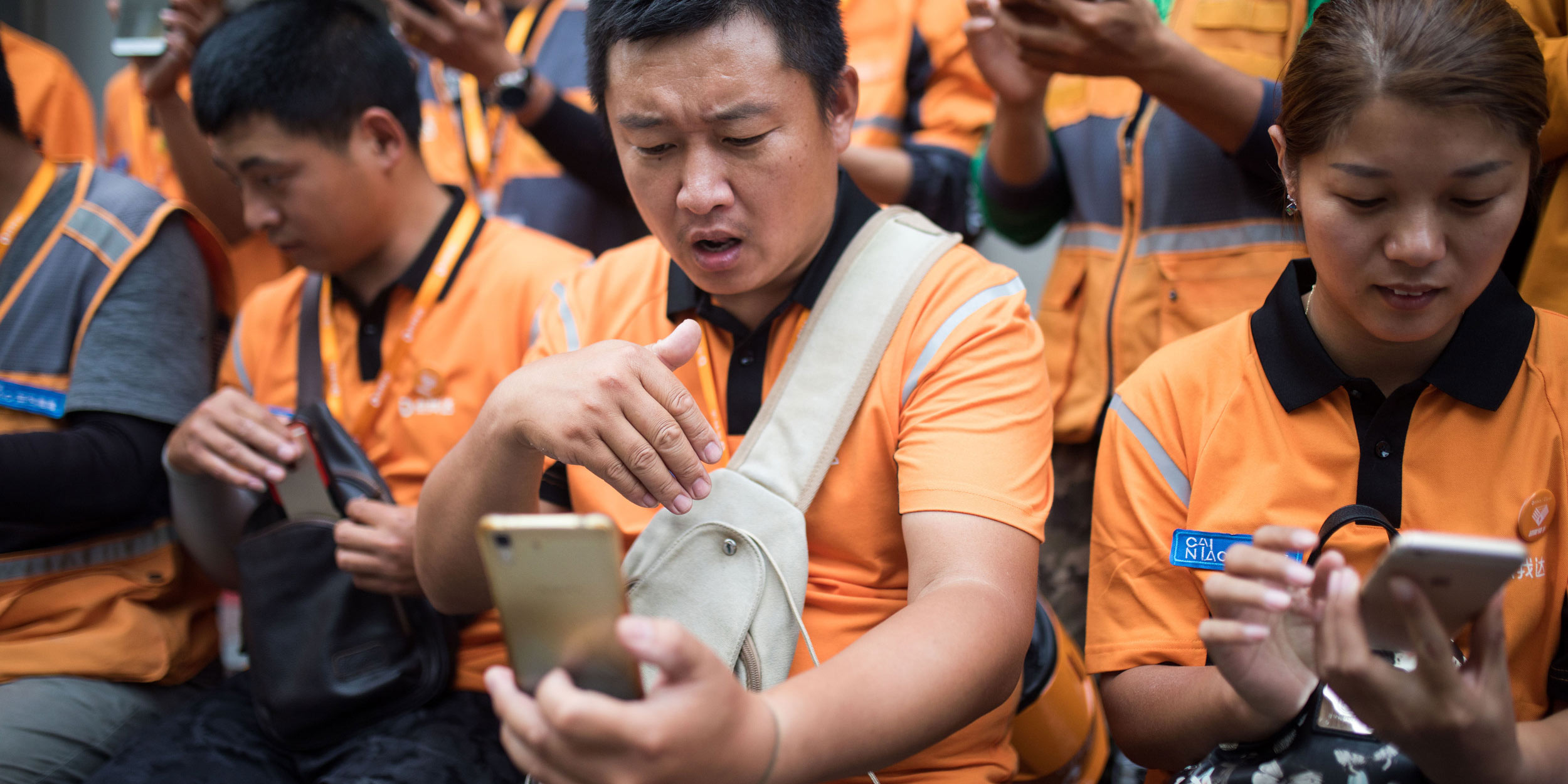
(Header image: Deaf delivery drivers check their phones, Weifang, Shandong province, 2018. VCG)